
AARTO Amendment Bill – the last set of changes
The AARTO Amendment Bill is/ was on President Ramaphosa’s desk for sign-off.
Once this is done, promulgation takes place, and AARTO will be rolled out country wide.
Some changes are for the better and some may be hard to swallow.
Here is a short summary of those that may have the biggest impact.
Starting of with the delivery of traffic offence notices or fines. Currently AARTO prescribes service in person on via registered mail. In future, electronic service will be applied. And 10 days after issuing a fine, it is presumed that the recipient did in fact receive the notice. The onus is on the vehicle owner to ensure correct contact detail is given to e-NaTIS.
Demerit point will come into effect as well. Up to 12 point on your driving license means you may legally drive. Above 12 points and the license will be suspended, and the suspension is three months for every point above 12. This is for individuals.
For companies or entities where a proxy is responsible for fines, the points will accrue on the vehicle used in committing the offence. This will then mean the vehicle in question are not allowed to be driven. If caught while suspended, the vehicle will be suspended for an additional 12 months. There are also additional more strict penalties for the directors of the company in such a case.
The owner of the vehicle always needs to know, who the driver of the vehicle is, and the following needs to be recorded: full names, copy of ID/ passport/ driving license, proof of postal and residential address, email and business address.
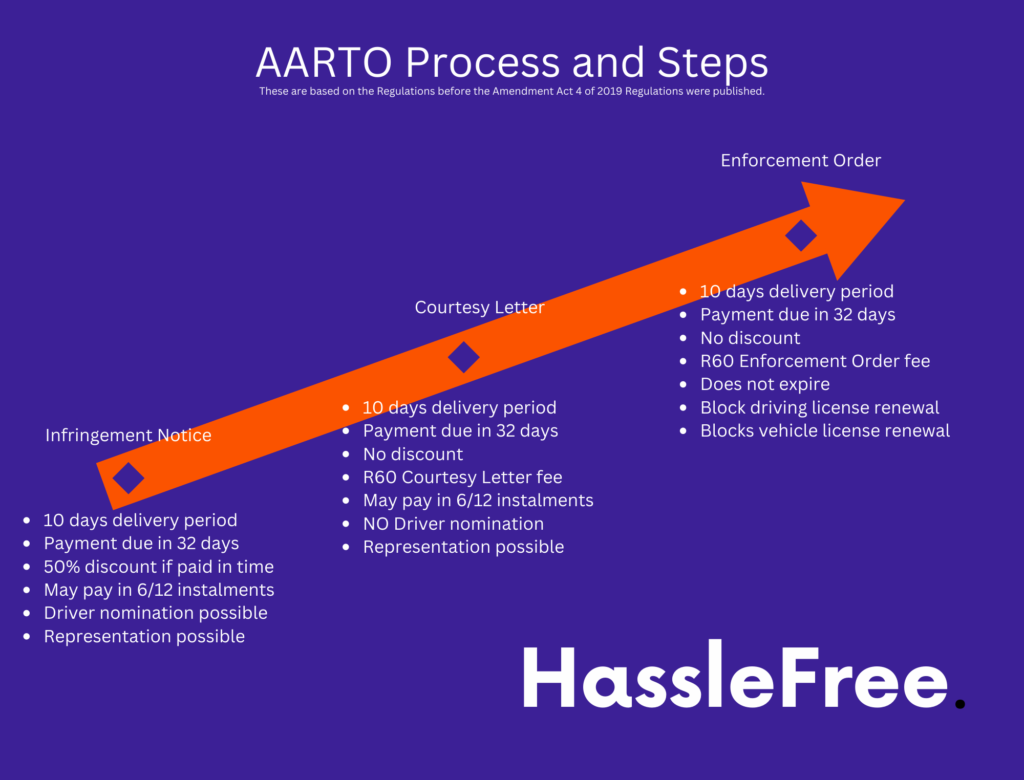
A change, which in the opinion of the writer, is great, is the fact that Warrants of Execution is removed from the Act. The process and status will be infringement notice, courtesy letter, and enforcement order. No more seizure of assets.
Transport companies with fleets of trucks are in for a surprise:
It is the responsibility of the owner to ensure the drivers are properly licensed with valid PrDP and driving licenses.
Overloading, transporting dangerous goods without the proper permits, and unroadworthy vehicles, along with the driving license and PrDP of the driver will be the fault of the owner, and the whole fleet of vehicles may be suspended.
A change, that is not published, but can be expected, is the amount due for each fine.
The current fees have not changed in eleven years, and as such, double what is being paid currently, may be on the cards. Time will tell.
A graphic to explain the AARTO process:
As it stands, these were the last changes and amendments, and we are waiting for judgement from the Constitutional Court.
Until then, the status quo is maintained.